Gas Chromatography (GC): Principles, Techniques, and Applications
Gas Chromatography (GC) is a powerful analytical separation technique used to identify, quantify, and purify individual components in a complex mixture. It belongs to the broader family of chromatographic methods, where separation occurs based on differential partitioning between a mobile phase and a stationary phase. In GC, the mobile phase is an inert carrier gas (typically helium, nitrogen, or hydrogen), and the sample is vaporized and carried through a column containing the stationary phase.
Invented in the early 1950s by A.J.P. Martin and R.L.M. Synge (who received the 1952 Nobel Prize in Chemistry for partition chromatography), GC revolutionized analytical chemistry. The first practical GC instrument was developed by Archer Martin and Anthony James in 1952. Today, GC is indispensable in fields like pharmaceuticals, environmental monitoring, forensics, food safety, petrochemicals, and clinical analysis. The global GC market exceeds USD 3-4 billion annually as of 2025, driven by advancements in detectors, automation, and hyphenated techniques like GC-MS (mass spectrometry).
Principles of Gas Chromatography
GC operates on the principle of differential migration: volatile or semi-volatile compounds partition differently between the gaseous mobile phase and the liquid or solid stationary phase coated inside a column. Analytes with stronger affinity for the stationary phase elute later (higher retention time), while those preferring the mobile phase elute sooner.
Key parameters:
- Retention Time (t_R): Time from injection to peak maximum.
- Capacity Factor (k): Measures retention relative to unretained peak.
- Selectivity (α): Ratio of capacity factors for two compounds.
- Resolution (R_s): Degree of peak separation.
- Theoretical Plates (N): Column efficiency measure.
Separation efficiency follows the van Deemter equation, balancing longitudinal diffusion, eddy diffusion, and mass transfer terms to optimize linear velocity.
Instrumentation and Components
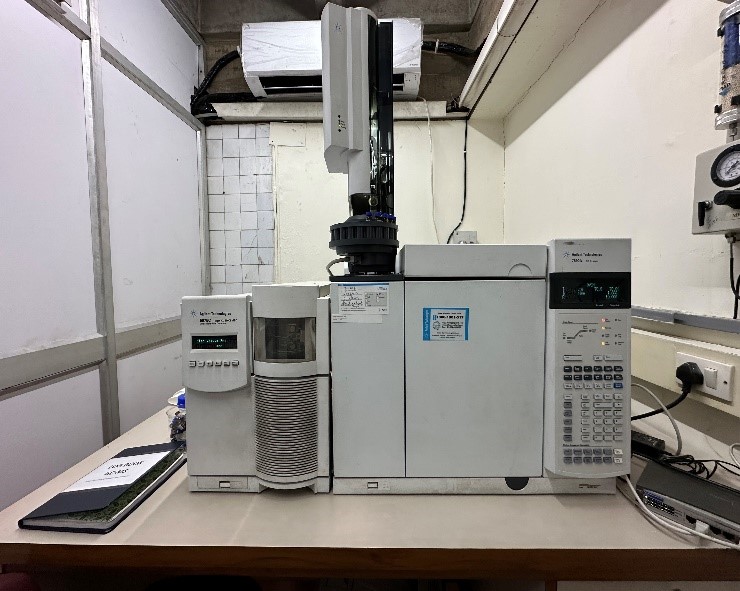
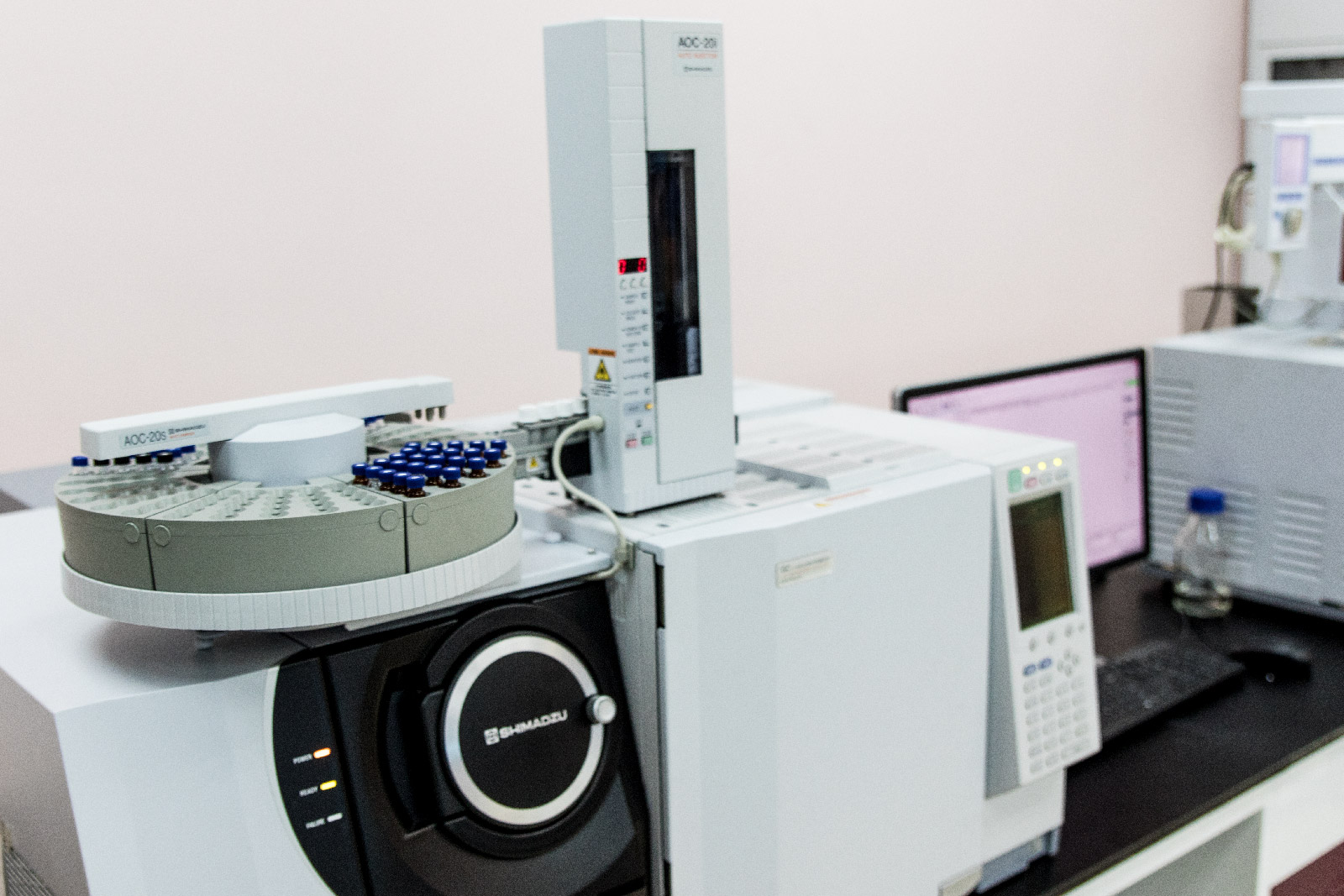
A standard GC system comprises:
- Carrier Gas Supply: High-purity gas (He preferred for efficiency; H₂ for speed; N₂ for cost) with regulators and flow controllers.
- Sample Introduction: Injector (split/splitless, on-column, headspace, purge-and-trap) vaporizes sample at 200-350°C.
- Column: Heart of GC; capillary (open tubular) columns dominate (0.1-0.53 mm ID, 10-100 m length) with thin stationary phase film (0.1-5 μm).
- Oven: Temperature-programmable (40-450°C) for gradient elution.
- Detector: Converts analyte presence to electrical signal.
- Data System: Integrates peaks, quantifies, and stores spectra.
Types of Columns and Stationary Phases
- Packed Columns: Older, lower efficiency; used for preparative GC.
- Capillary Columns: Wall-coated open tubular (WCOT), support-coated (SCOT), porous layer (PLOT).
- Stationary Phases: Polysiloxanes (non-polar to polar), polyethylene glycols (polar), chiral phases for enantiomers.
Common phases: DB-1 (100% dimethylpolysiloxane, non-polar), DB-5 (5% phenyl), DB-WAX (polyethylene glycol, polar).
Detectors
Detector choice depends on sensitivity and selectivity:
- Flame Ionization Detector (FID): Universal for organics; detects carbon-hydrogen bonds.
- Thermal Conductivity Detector (TCD): Universal, non-destructive; measures gas thermal conductivity.
- Electron Capture Detector (ECD): Selective for halogens, nitro groups (pesticides).
- Nitrogen-Phosphorus Detector (NPD): Selective for N/P compounds.
- Mass Spectrometer (GC-MS): Gold standard for identification; provides mass spectra.
- Others: Photoionization (PID), flame photometric (FPD for S/P).
Applications
GC excels for volatile/semi-volatile compounds:
- Environmental: VOCs, PAHs, pesticides, PCBs.
- Pharmaceutical: Residual solvents, impurity profiling, chiral analysis.
- Food/Beverage: Flavor compounds, contaminants, fatty acid methyl esters (FAMEs).
- Petrochemical: Hydrocarbon profiling, gasoline analysis.
- Forensics: Drugs of abuse, accelerants in arson.
- Clinical: Blood alcohol, metabolic profiling.
Headspace GC analyzes volatiles in solids/liquids; pyrolysis GC for polymers.
Advantages and Limitations
Advantages:
- High resolution/separation power.
- Excellent sensitivity (pg to fg detection limits with MS).
- Quantitative accuracy.
- Versatility with detectors.
Limitations:
- Samples must be volatile/thermostable.
- Non-volatile compounds require derivatization.
- Matrix interference possible.
- Helium scarcity drives alternatives (H₂, N₂).
Recent Advances (as of 2025)
- Fast GC: Short, narrow columns reduce analysis time to seconds.
- Multidimensional GC (GC×GC): Two columns for complex mixtures (e.g., petroleum).
- Portable/Miniaturized GC: Field-deployable for on-site analysis.
- Green GC: Hydrogen carriers, reduced solvent use.
- AI/Data Integration: Automated peak deconvolution, predictive maintenance.
Sample Preparation and Method Development
Critical steps: Extraction (SPE, SPME, QuEChERS), derivatization (silylation for polar compounds), calibration (internal/external standards). Method validation per ICH/USP ensures accuracy, precision, linearity, LOD/LOQ.
Conclusion
Gas chromatography remains a cornerstone of analytical chemistry, offering unparalleled separation and detection for volatile compounds. Its evolution from packed columns to multidimensional GC-MS continues to address complex challenges in science and industry. With sustainability focus and digital integration, GC will remain vital for quality control, research, and regulatory compliance well into the future.
More articles by ZMR Researche:
https://www.zionmarketresearch.com/de/report/filtered-storage-cabinets-market
https://www.zionmarketresearch.com/de/report/packaging-market
https://www.zionmarketresearch.com/de/report/respiratory-syncytial-virus-vaccine-market
https://www.zionmarketresearch.com/de/report/data-center-support-infrastructure-market
https://www.zionmarketresearch.com/de/report/retail-earplugs-market