Industrial Sulfuric Acid: Essential Chemical for Manufacturing Industries
Industrial Sulfuric Acid (H₂SO₄) is one of the most important and widely produced chemicals globally, often called the “king of chemicals” due to its central role in numerous industrial processes. It is a colorless, odorless, highly corrosive, dense, oily liquid that is miscible with water in all proportions, releasing significant heat upon dilution. Concentrated sulfuric acid typically refers to 98% purity, while lower concentrations (e.g., 93-96%) are common in bulk transport and use.
Global production exceeds 250-280 million metric tons annually as of 2025, with China accounting for over 35% of output, followed by the United States, India, Russia, and Morocco. The vast majority (over 90%) is produced via the contact process from sulfur or pyrite. Sulfuric acid’s versatility stems from its strong acidity, dehydrating properties, oxidizing capabilities, and catalytic role, making it essential in fertilizers, metals processing, petroleum refining, chemicals manufacturing, and batteries.
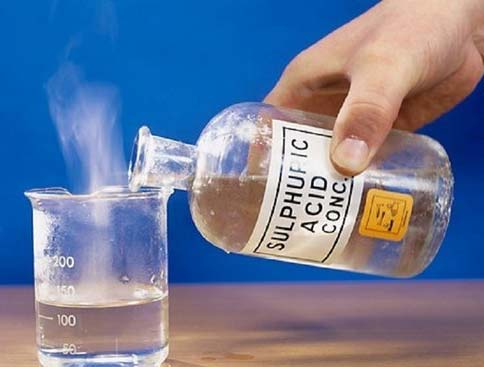
Chemical and Physical Properties
Sulfuric acid is a diprotic strong acid with the formula H₂SO₄. Key properties include:
- Molecular weight: 98.08 g/mol.
- Boiling point: ~337°C (decomposes before boiling at atmospheric pressure).
- Melting point: 10.3°C for 100% H₂SO₄.
- Density: 1.83-1.84 g/cm³ for 98% acid at 20°C.
- Viscosity: High for concentrated forms (26 cP at 20°C for 98%).
- Azeotrope: Forms a constant-boiling mixture at 98.3% with water.
It is highly hygroscopic, absorbing moisture rapidly, and acts as a powerful dehydrating agent (e.g., charring carbohydrates). Dilution is exothermic, requiring careful addition of acid to water. Fuming grades (oleum) contain dissolved SO₃ for enhanced reactivity.
Production Methods
Over 95% of industrial sulfuric acid is produced by the double contact double absorption (DCDA) process:
- Sulfur Burning: Elemental sulfur is melted and burned to SO₂.
- Catalytic Oxidation: SO₂ is oxidized to SO₃ over vanadium pentoxide (V₂O₅) catalyst at 400-450°C (contact process).
- Absorption: SO₃ is absorbed in 98-99% H₂SO₄ to form oleum (H₂S₂O₇), then diluted to desired strength.
- Double Absorption: Intermediate absorption improves conversion efficiency (>99.5%).
Alternative feedstocks:
- Pyrite Roasting: FeS₂ → SO₂ (declining due to impurities).
- Smelter Gas: Byproduct from copper/zinc smelting.
- Hydrogen Sulfide: From oil/gas sweetening.
Modern plants emphasize energy recovery (steam generation) and emissions control (tail gas scrubbing).
Applications and Uses
Sulfuric acid’s consumption breakdown:
- Fertilizers (60-70%): Phosphoric acid production for phosphate fertilizers (superphosphate, ammonium phosphate).
- Metals Processing (10-15%): Leaching (copper, uranium), pickling steel.
- Petroleum Refining: Alkylation catalyst.
- Chemicals: Detergents (alkylbenzene sulfonates), pigments (TiO₂), explosives, dyes.
- Batteries: Lead-acid batteries (electrolyte).
- Water Treatment: pH adjustment.
- Other: Rayon, hydrochloric acid regeneration.
Oleum is used for sulfonation and high-strength reactions.
Health and Safety Considerations
Sulfuric acid is highly corrosive:
- Acute exposure: Severe burns, tissue necrosis; inhalation causes pulmonary edema.
- Chronic: Dental erosion, respiratory irritation.
- OSHA PEL: 1 mg/m³ TWA.
- Handling: Requires PPE (acid-resistant suits, face shields), spill containment, and emergency showers.
Transportation classified as UN 1830 (corrosive). Storage in lined tanks with venting.
Environmental Impact
Production emissions (SO₂, acid mist) are tightly controlled via scrubbing. Spent acid regeneration reduces waste. Mining phosphate rock for fertilizers links to environmental concerns (fluoride, heavy metals). Recycling from battery acid and alkylation units promotes circularity.
Market and Economics
Price volatility tied to sulfur costs (~USD 400-600/ton for 98% acid in 2025). Major producers: Aurubis, Glencore, Mosaic, Nutrien. Asia dominates capacity expansions.
Conclusion
Industrial sulfuric acid underpins modern manufacturing, particularly agriculture and chemicals. Its production efficiency, recyclability, and irreplaceable role ensure continued demand, balanced by stringent safety and environmental management in a sustainability-focused era.
More articles by ZMR Researche:
https://www.zionmarketresearch.com/de/report/chambered-doctor-blade-systems-market
https://www.zionmarketresearch.com/de/report/femoral-canal-brush-market
https://www.zionmarketresearch.com/de/report/idi-contact-technology-market
https://www.zionmarketresearch.com/de/report/oil-mist-separator-market
https://www.zionmarketresearch.com/de/report/cross-traffic-alert-market